Greetje Hein – Time #5
Pocket watch.
The next step was to make the clock smaller. In the 15th century, there was a need for an accurate timepiece to facilitate navigation at sea. Clocks were usually too large and too heavy to take on board. In addition, the (pendulum) clock mechanism was too sensitive to the ship’s motion.
The invention of the spring mechanism was crucial to solving this problem and, at the same time, to the development of the wristwatch. However, these portable timepieces were not yet very accurate and had only an hour hand.
In 1675, Robert Hooke and Christiaan Huygens independently developed a system in which the watch’s mainspring caused a balance wheel to oscillate back and forth—a motion similar to that of a pendulum. This significantly improved the watch’s accuracy.
In 1957 a battery was used to power the watch instead of a spring.
For the watch chain, I used the buttonholes from jeans.
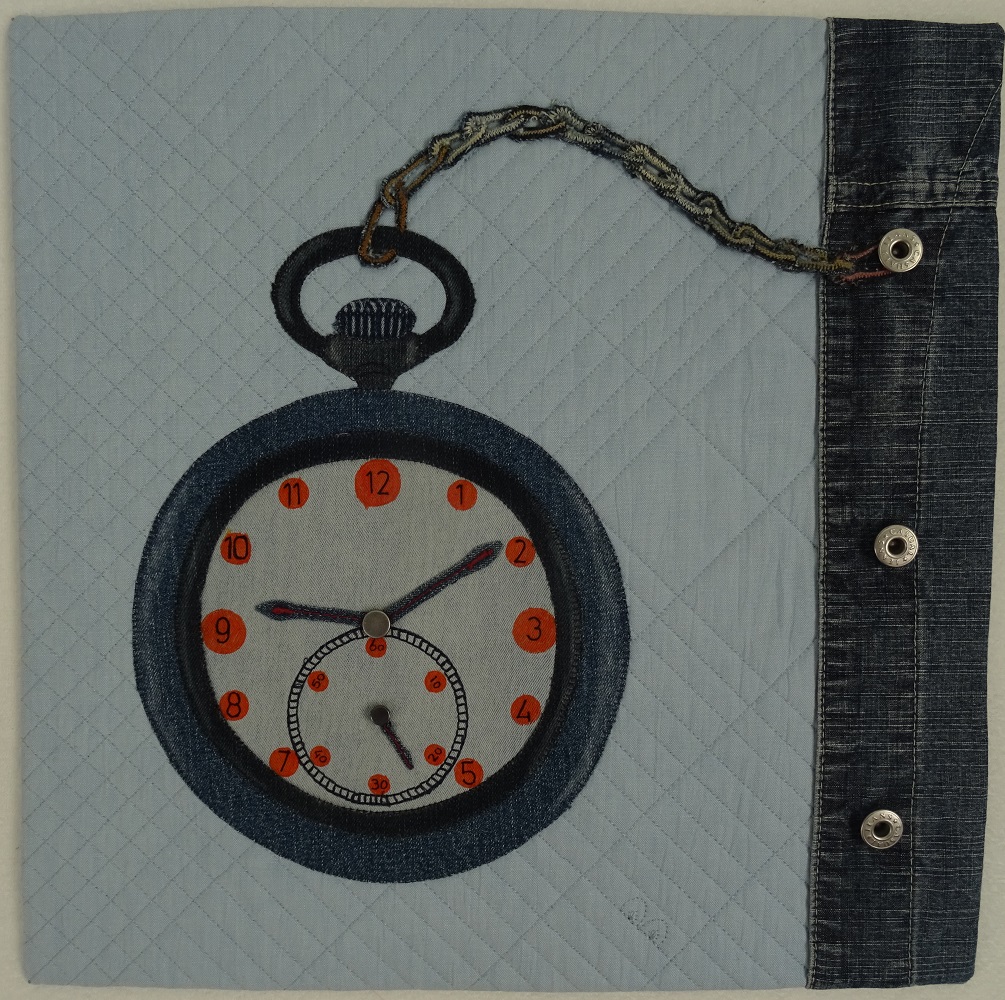
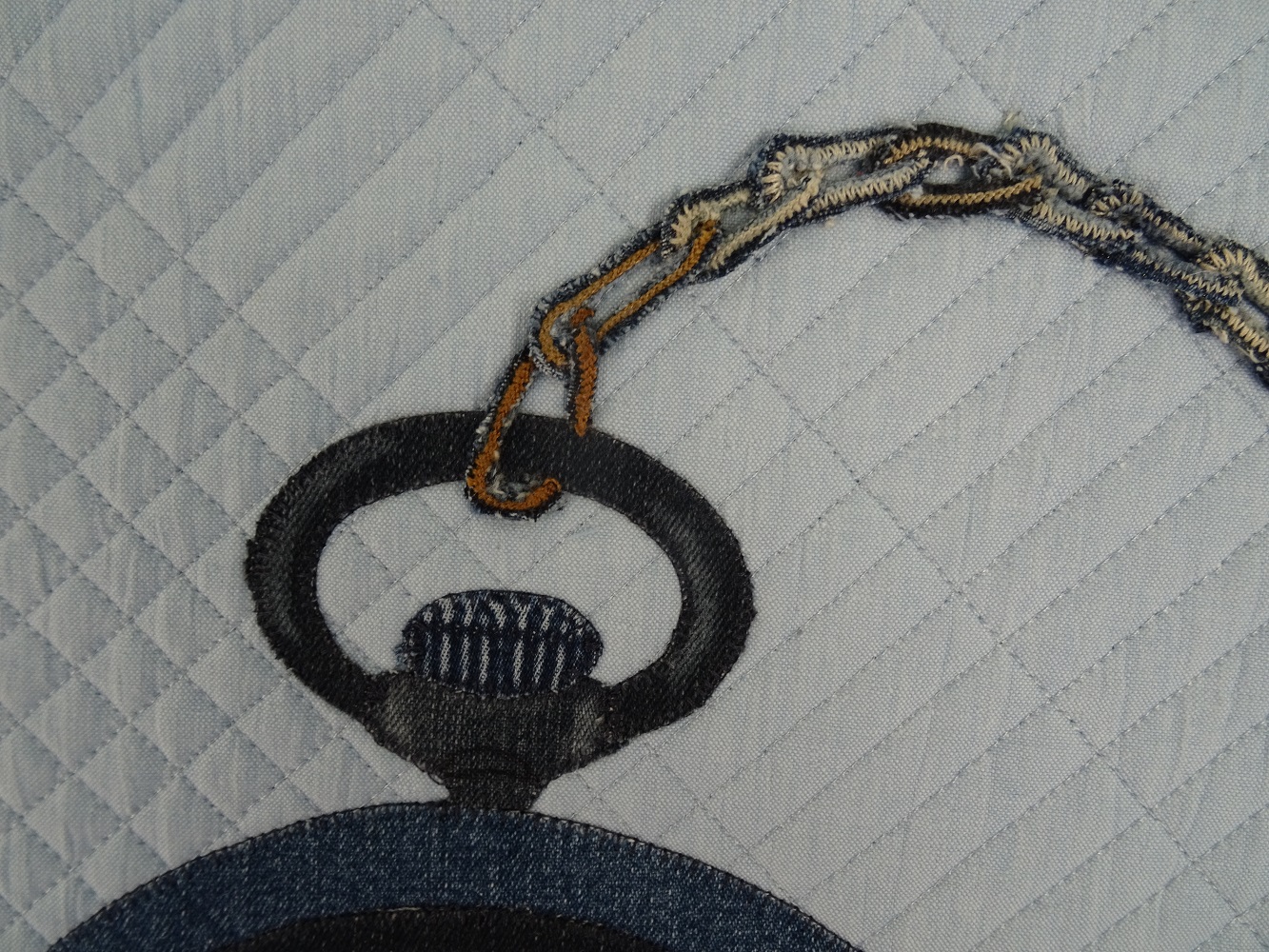


What impresses me most with your quilt is the chain. You are a genius! OPf course, your quilt is a nice addition to your story of the history of counting the time.
I love the way you are educating us on the evolution of time pieces. As Maryte has said the use of the button holes is really clever, well done!
Yet another fascinating addition to your presentation of the history of clocks.
I am truly impressed by your use of upcycled denim. It was so clever to use the button placket from a shirt – it couldn’t have been a better fit! And I am absolutely amazed by the idea of using the buttonholes! Excellently executed.
Wow, who would have thought to use buttonholes for a chain?! Thanks for the history you have provided. It is interesting how inventions are stepping stones to newer and (mostly) better inventions.
I love how you continue to use deconstructed jeans in your series. It was a great idea to make the watch chain from the buttonholes – genius! As always your design and stitching are wonderful
Love the education in the development of time pieces. That chain is mind boggling! How did you get them to intertwine like that? The quilting is a dream. Wow!
A great continuation of your series, very cleverly made and a great illustration of the work of 2 illustrious scientists.
Love the history lesson and also the simplicity of the design, the chain is a masterpiece.
With each of your quilts I learn something about clock making and history ! For this one I love the use of buttonholes for the chain !