Maryte Collard – Decay #4
Composting fabrics part 2
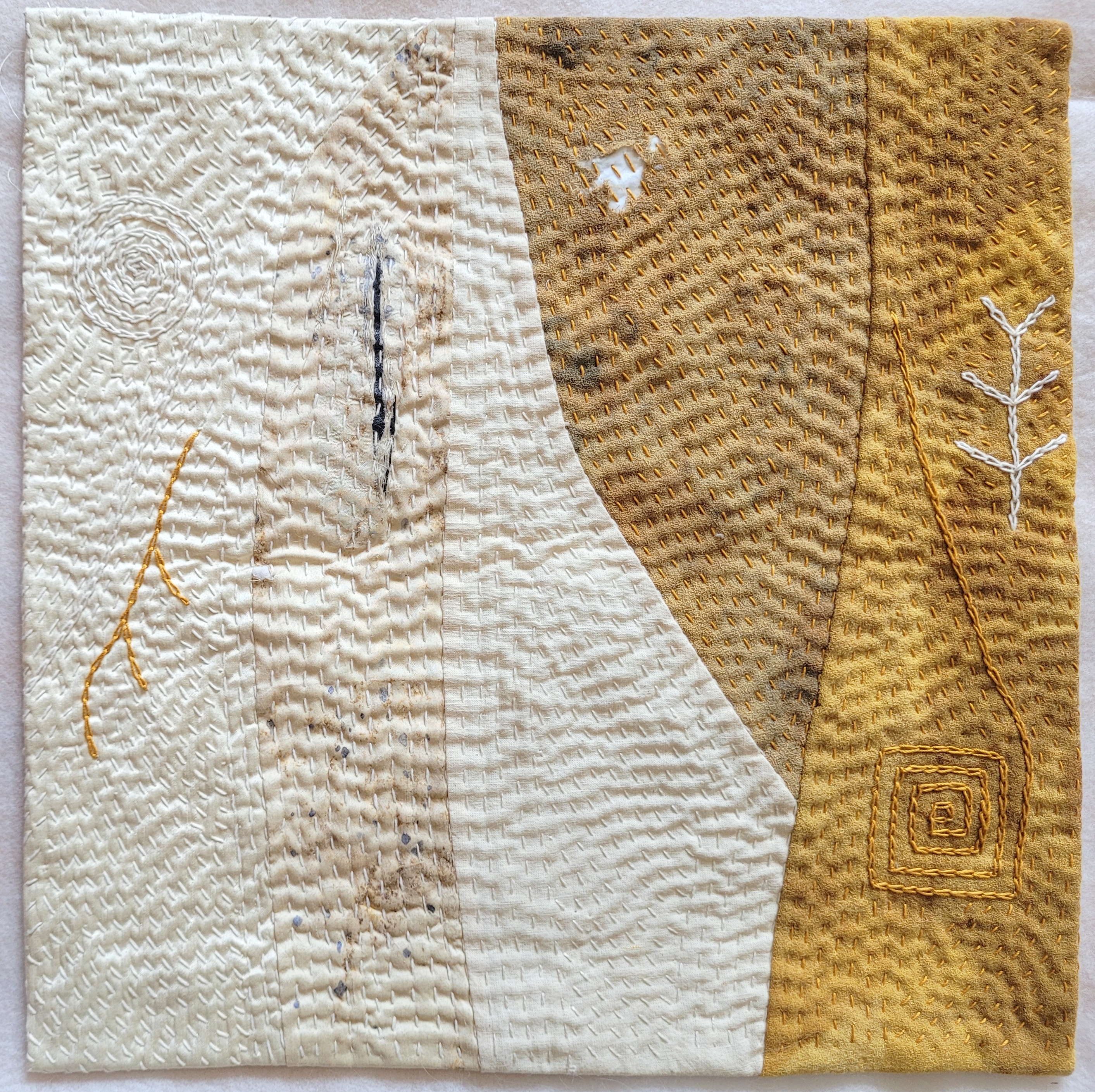
In this quilt, I’m showing the results of composting dupioni silk and wool fabrics. The dupioni silk was originally off-white, and the wool fabric was yellow—previously unsuccessfully dyed with some leaves. Neither fabric had holes at the start.
After being buried in dirt mixed with leaves and rotten tomatoes for seven weeks, both fabrics developed dark spots and holes. I believe the damage occurred where the fabrics contacted the rotten tomatoes. Their original colors also became muted.
From my experiment of composting fabrics I can draw a conclusion that plant based fibers (cotton, linen) desintegrate much faster that animal based fibers (silk, wool).
For my quilt, I selected pieces of both fabrics with holes and placed them next to pieces of the original fabrics to show the contrast. Behind the holes, I added contrasting fabrics. In the center is a piece of neutral cotton.
Everything is stitched by hand using long, kantha-style stitches.


 FIFTEEN BY FIFTEEN
I really like the way that you are decaying your fabrics, not only id the decay visible by the fabrics have a dirty look to them which adds meaning to the piece. Wonderful hand stitching!
It must be so interesting for you personally to see the composting process of the fabrics. For us it is a joy to see a finished piece made from these materials. Love the colors and the holes that have emerged.
Beautiful hand stitching.
You have created an interesting science project that we were all involved in! Your outcome is effective and you have used it in the composition to great advantage. The Kantu-style stitching is perfect for your piece.
I can’t help smiling when reading your “decay process” ! even with all this time buried in dirt your fabrics stay beautiful ! And the hand stitching you add gave them an interesting texture.
Your composting process has certainly given you a very interesting set of fabrics and the contrast between the original and dyed fabrics is so striking. The shapes you have used to illustrate the differences are very elegant, and I love your kantha stitching. Lovely work
Love the all over kantha stitching providing all that texture. A very interesting process. I tried my hand at it as well, but left the fabrics not long enough in the earth. Yours have turned a beautiful color, especially the wool. Very effective way of decay!
Interesting observation of the effect on these materials. Great quilting design.
What an interesting experiment. The effect of the decay is clear even after so short a time. Your stitching is great – I love kantha work and the textures it produces. Excellent.
What a wonderful idea you have in this work. You spark my imagination and make me curious about what’s next. your stitching is great.
What a magnificent piece. I love the colours you have achieved with the composting of the fabric. I especially love your hand quilting technique, it gives so much personality and movement to your work. Great attention to details and embroidery. Excellent! Bravo!
Lovely how you show us the diffentence between the original and the composted fabrics. Very nice hand quilting.
You really made a striking piece out of the composted fabric. Such a nice experiment with interesting results. I love the kantha handstitching combined with some different patterns.
You’ve created a lovely composition highlighting your decayed fabrics. Love how the colors became muted and frayed through your experiment. Your hand stitching gives such beautiful texture and provides the perfect background for the deteriorating fabrics. Well done.
Very interesting experiment and visually pleasant result.