Maryte Collard – Decay #6
Backwards Kawandi
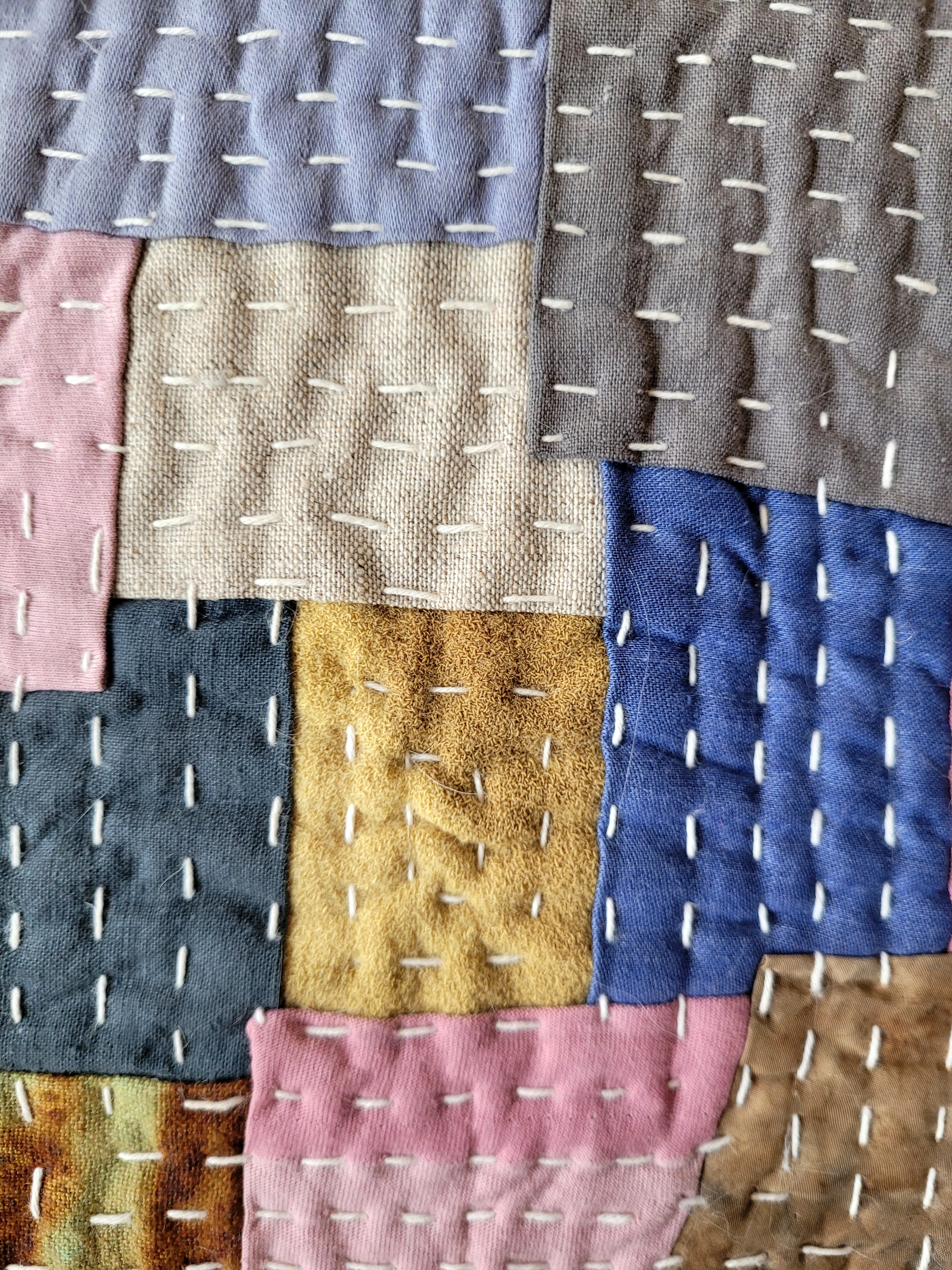
As I said in the first post I was interested not only in fabric decay but also the use of decayed fabrics. Decay #1 I dedicated to Japanese boro. The next 4 quilts were stitched using kantha stitch that originated in India. I had many scraps left from 5 previous projects and I decided to make a kawandi quilt. The technique was developed by the Siddi people, who are of African descent and settled in parts of India. Old sarees are used for the backing, and scraps of different colors are hand stitched with running stitch on top. The stitching starts from the outside and goes inwards. The centerpiece is called the belly and usually a few grains of rice are added for luck. No kawandi is properly finished until each corner has a phula, or decorative folded flower.
Making my kawandi quilt was really challenging and what you see is the 3rd attempt of making a kawandi quilt. The first quilt I started with the backing of 16×16 inches but still it shrank and it was smaller than what I needed (15×15 inches) The 2nd one was about the right side but I didn’t like how the batting got pushed towards the center and was sticking out. I understood then why it is called “the belly”. Then I started making my kawandi quilt starting from the center going towards the esges so I call it a backwards kavandi. It doesn’t have a belly and I didn’t add phulas, decorative folded flowers in the corners. That’s my story.


As always, with the last entry of the year I add a photo of all six quilts. This time it is Decay:

 FIFTEEN BY FIFTEEN
You know the rules so you can break them, right? Love your kavandi!
Fantastic stitching and layout of your design. Thank you for the explanation.
What a fitting final piece in the series. I really admire the effort you have gone to to decay your fabric, and finally, to achieve the result you were looking for! Love it!
A lovely soft look to the kwandi and the stitching brings together all of the old fabrics. This is a great end to your series
You have created a truly fascinating series.
Kawandi sounds so interesting and I understand that it is not the easiest thing to learn.
Really beautiful hand stitching that brings the surface to life. Beautiful colors.
A beautiful little kawandi. I have made some of these on holidays in India and they are challenging! I’ve always thought that starting in the middle would make the process easier – you have proved the point. Lovely work.
Your story is very interesting, especially since I don’t know the method and I don’t embroider by hand at all. I really appreciate what you did and I would be happy to learn it.
I like your story of the kawandi ! It is a technic I wanted to try but I have never taken the time to start … and I read this is the third one !!!
I like the colors tou used and how they echoed the colors in the previous quilts of the series.