Maryte Collard – Decay #1
Wear and Tear
Decay is a vast and intriguing subject. Nearly everything in this world ages, decays, and eventually disintegrates. While natural materials often follow a swift cycle of decay, certain man-made materials degrade so slowly that it takes generations to witness the process.
As an artist working with textiles, I chose to explore fabric decay—examining the many ways it manifests and finding creative solutions to extend the life of fabric, even when it shows signs of deterioration.
For my first quilt, I focused on the wear and tear of fabrics. In today’s world, where we are inundated with an abundance of textiles, many people discard worn and torn fabrics, contributing to growing landfills. However, the Japanese tradition of boro offers a different approach.
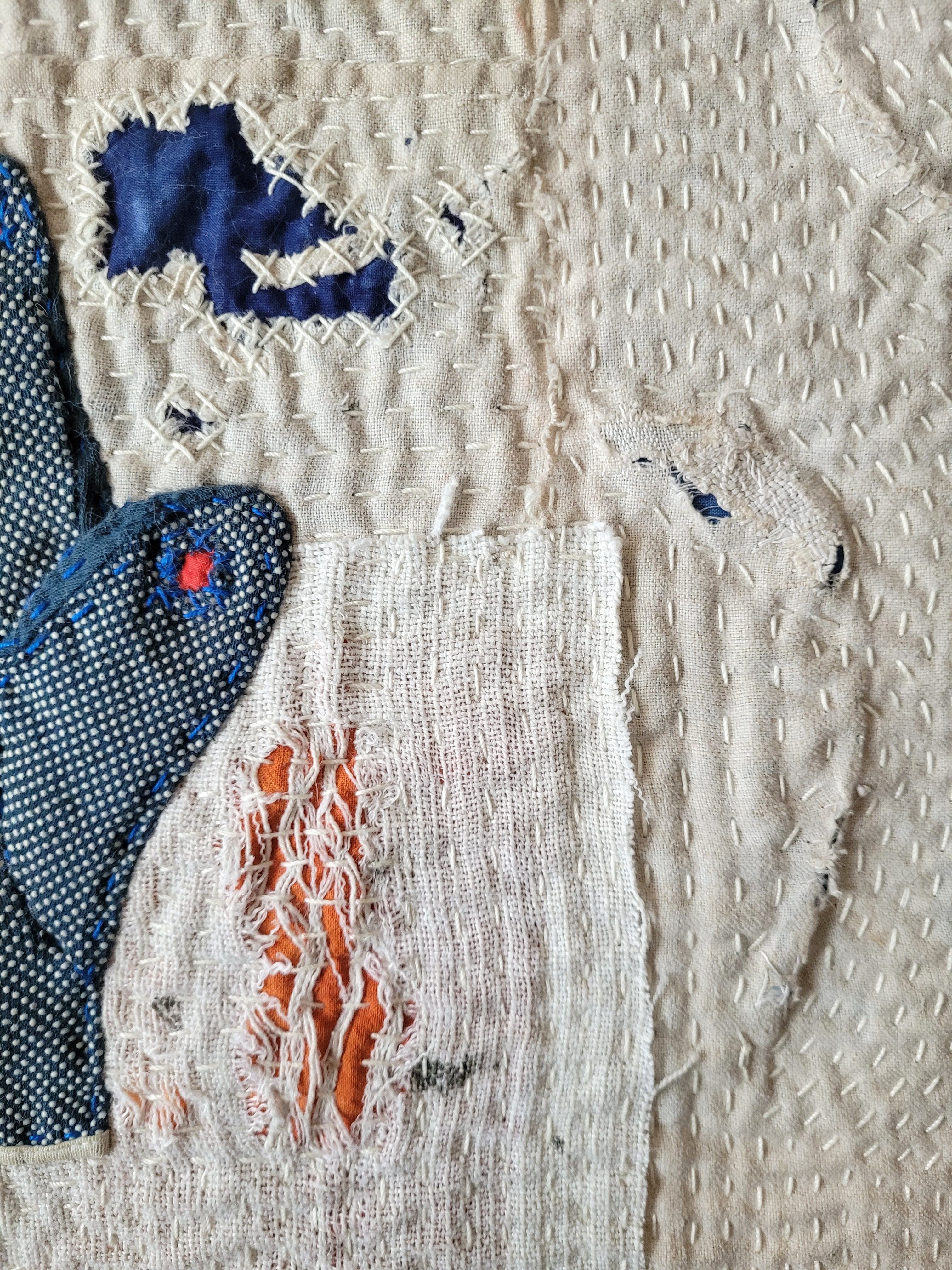
Boro (or boromono) translates to “rags” and refers to textiles from rural northern Japan that were repeatedly patched and mended to prolong their use. Rooted in the philosophy of mottainai—a respect for resources and regret over waste—boro emerged from economic and environmental necessity. Today, it has evolved into an art form and meditative practice.
In creating my quilt, I incorporated a worn-out quilting glove, fragments of a hand-embroidered tablecloth that had been used until it developed holes, and a piece of hand-woven linen towel. The tablecloth itself had signs of earlier mending before being discarded and given to me.
Every element of the quilt is hand-stitched, honoring the traditional boro techniques and embracing the beauty found in fabric decay and restoration.

 FIFTEEN BY FIFTEEN
Very interesting take on the theme and lovely execution, brilliant!
Very intriguing reuse of old textiles. Love the vibrant colors showing through the holes.
Your stitching is truly beautiful.
Great idea, I really like the way that you have accentuated the worn parts of the fabrics. Lovely work, well done.
Our grand mothers used to mend worn fabric and in Japan or India and many other places they reused in layers worn fabric to create a new one. I like the philosophy behind that, and your piece illustrate this idea perfectly.
Fascinating use of old and worn materials. The compostion is beautiful in its simplicity. The hand quilting is appropriate to the overall design. Brava!
This reminds me of the age old Durham quilts in which holes were just patched up with new layers, resulting in quilts of five or even seven layers. Great use of old textiles, your hand stitching is beautiful and adds great texture.
Love your interpretation it is great to be able to use old fabrics in this traditional method. I am not sure of the hand.
the subject is very good for our work with fabrics. Every detail of your work proves what you described. I really like Boro even though I haven’t tried it yet. The choice of fabrics is excellent.
Great use of old textiles. The stitching unifies all the different textures and definitely reflects Japanese boro and Indian kantha. Well done.
Beautiful concept. I love all your hand stitches. Great choice of colours for this piece. You are a true master. Beautiful!
I like the way that you have incorporated these worn and fragile fabrics into the boro-style piece. It is a great idea and beautifully worked
A beautiful and unique way of presenting decay. The worn fabrics and the boro style hand stitching adds to the story it tells about you. Lovely!
What a nice idea to choose fabric decay for this year’s theme. The boro technique is a beautiful example of mending old textiles. Lovely work.
What a clever idea to use the boro technique. This is decay!