Genevieve Guadalupe – Time #1
Time is an illusion.
Many physicists and philosophers view time as an illusion, not because it does not exist at all, but because our sense of a constant, flowing “now” is a construct of the brain or emerges from deeper, timeless quantum processes. This challenges time’s fundamental role in reality and fuels theories in which all moments might coexist. Relativity shows that time is not absolute but relative, while quantum physics suggests it could arise from entanglement, with our experience of flow tied to increased entropy and our limited perception. Together, these ideas hint at a static, timeless underlying reality.
Time #1: Trying to catch up with time
The sense that time moves faster than we can keep up with, known in psychology and sociology as time poverty or social acceleration, is a well-documented phenomenon. Research shows this feeling growing sharper due to a blend of biological memory processes, rapid technological changes, and a societal Red Queen effect that demands ever-faster movement just to stay in place. Modern life is defined by social acceleration, a theory in which changes in technology, society, and daily pace feed on one another in a continuous loop. Even as technology automates tasks to “save time,” the number of activities we feel compelled to undertake has increased more quickly than automation can reduce them.
The human brain doesn’t experience time like a clock; perception is highly subjective and shifts with age and mental state.
Known as the Memory Content Hypothesis, the brain measures time by the density of new experiences. As adults fall into routines, fewer unique memory chunks are formed, causing years to feel shorter in hindsight. Recent studies indicate that aging leads the brain to register fewer distinct neural moments within a given period, helping explain why time seems to slip away.
Acute stress can cause the brain to overestimate time intervals, making the available time feel even scarcer than it is.
Materials and technique: cotton fabrics, printmaking inks, poly thread, cotton batting, embroidery floss. Monoprint on fabric, machine quilted, hand embroidery, thread painting.
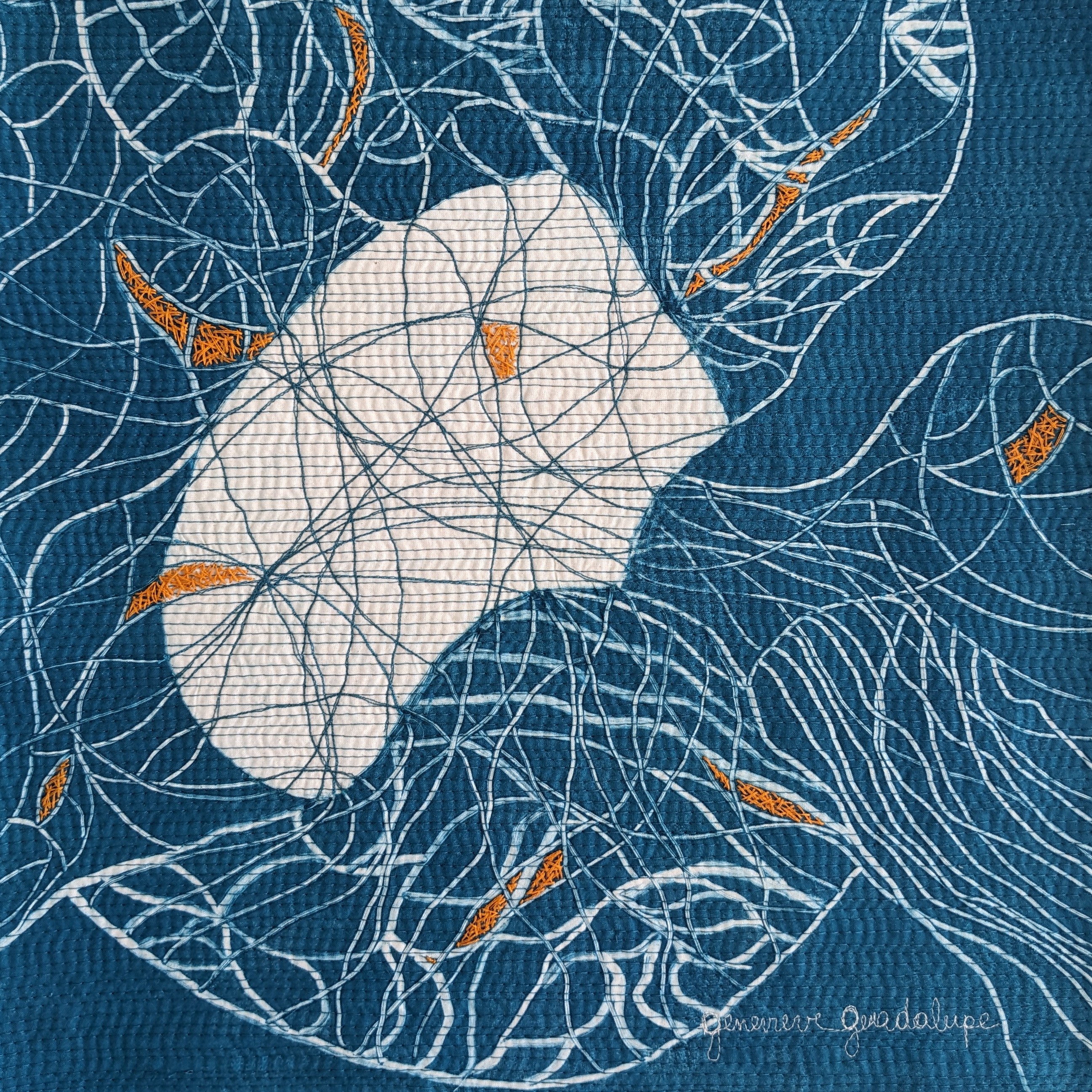
 FIFTEEN BY FIFTEEN
OMG, what an interesting, scientific approach to the subject and its artful visualisation, great job!
Wow! You have put a great deal of thought into this subject and this piece is really interesting. Lovely work.
I am glad to see that you took a scientific approach to understanding of time. You also used advanced techniques to make a quilt. I really like how the lines interact and how the clusters of memory form in this chaos of entanglement. Very interesting work.
I am impressed by this scientific approach ! I like how the quilt describes the acceleration of time and the fact that we can be overwhelmed when too many things give us the feeling to run out of time.
Very interesting challenging thoughts about time that you have captured in your piece in a beautiful way.
Thank you for the explanation, your quilt depicts this scientific approach. Like the use of colour for the background with the monoprinting. Great approach to a complex subject.
I am not only impressed by your scientific approach of this theme but also by the way you executed it. Bravo.
I love how you’ve translated complex neuroscience into tactile art. You’ve brought the science of memory and time to life in such a beautiful, moving way. Well done.
Without referring to the scientific explanation you gave, which in itself is very interesting, I refer to the execution. Very interesting work, the tangle of threads that represents the brain and the choice of color. Perfect
What an interesting set of scientific and psychological constructs on the subject of time. It certainly is a difficult concept to tie down, but I like the way that your abstract work hints at the complicated way that the brain copes with these. Lovely work and very moving
Wow, I concur with all previous statements. You have selected a unique way of portraying time. The use of complementary colors was a wise decision and helps to control what could have been chaos. I’m excited to see what comes next!
The scientific view of time is definitely complex. I have tried, and failed, to understand these theories. Your quilt illustrates the complexities very well and the colour choice helps to calm the potential chaos of the timelines.
What a different approach of the theme. Very interesting. I love the way you made your quilt, especially the orange details.